Wednesday, July 17, 2013

Exercise of the Week: Learning to Hip Hinge

One of the more difficult movements to teach a "newbie" to strength training is the hip hinge. We've talked about the importance of these movements in people who may have cranky knees or other issues that prevent squatting or lunging motions.


It's an important movement to understand as it serves as a precursor to an entire category of exercises for most trainees. Any RDL, deadlift, rack pull and even single leg deadlift variations all require proper hip hinging in order to protect the spine and ensure correct timing and sequencing in the pattern to optimize strength development.

I actually remember my first attempt at teaching the pattern to a high school athlete back in 2007. Another young coach and I spent a solid 10 frustrating minutes trying to turn a half squat into a proper RDL. Luckily since then I've gained a little experience and have found a few tricks along the way to help speed along the process. Here's one...

Kneeling Hip Hinge


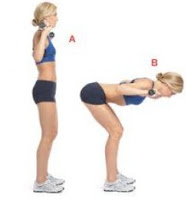
By getting down on two knees, we prevent the possibility of driving the knees forward at all as you might in a squat. The only way to get down is to push the hips back. The one issue you might run into is keeping the torso vertical and pulling the shoulders back along with the hips when in reality you should see the shoulders come forward (with a neutral spine, of course) as the hips go back.

This might not seem to exciting from a strength building standpoint but it's important to get the patterning down before adding any serious load. In the meantime you can use various bridging variations to fill in the strength gaps while you're learning the new movement.


Happy Deadlifting!


Thursday, July 11, 2013

Mistakes I’ve made and lessons I’ve learned in coaching and in life:

I turned 30 celebrated the 9th anniversary of my 21st birthday earlier this year and started thinking about some of the mistakes I’ve made as a coach and in life. A lot of coaches and motivational speakers try to teach from their mistakes. "Don't make the mistakes I did." While that can help sometimes, I believe people succeed often because of, not in spite of their mistakes. If you've read Outliers by Malcolm Gladwell you've seen this before.

Here’s a list that I stopped at 31 but certainly not because I ran out of mistakes. I'm still working on improving a lot of these.


1.       Teaching hang clean to 14 year old introverted girl day 1:
The first program I ever wrote was for a 9th grade athlete who was as shy as they came. The first exercise on that program was a Hang Clean. 4 or 5 older, male coaches stood around (just trying to help, mind you) critiquing and cueing and trying to correct. We didn’t see her after a couple of weeks at the most.

2.       Dropped medicine ball on face of client in supine position
In an adult bootcamp-style class I had the bright idea of using supine explosive chest passes (where I could catch, stabilize and drop the ball) as a station. A 26 year old woman at her first workout caught one in the nose with a 6 lb ball on the first rep.

3.       Had my uncle try to perform a split-squat and strain a hip flexor without screening the movement first
My uncle started to train with me at one point and day-1 I sidelined him for a couple of weeks.

4.       Trained people too hard
I once used prowler pushes for “Tabatas” (20 seconds on, 10 seconds off for 8 rounds) with personal training client. Luckily she was a good sport and I became good friends with her and her husband. I was even more fortunate that she didn’t have a heart attack as a result of my stupidity

5.       Trained people too easy
Better safe than sorry, but there were certainly times where I let athletes and clients leave a lot on the table or just got too soft with their programming

6.       Talked bad about other programs based on what I’d heard and not what I knew
It’s funny how much I knew before I knew anything at all

7.       Not asking enough questions
I feel like I got a great head start in the industry out of grad-school thanks to my mentor Lee Taft but I wasted a lot of years after I knew I was interested in strength and conditioning as an athlete of his by not taking advantage of his experiences to learn from.  I worked hard and did what was asked but it would have been a much simpler road if I recognized this at 18 instead of 22 or 23

8.       Not making mistakes
Yes, I made a mistake by not making mistakes. In other words I didn’t put myself out there or “Go ahead and be crappy” to take my lumps and learn some lessons. I was waiting for “perfect” when I should have been simply striving for “better”. 


9.       Being afraid to say “I don’t know”
When I was younger I felt like I had to have all the answers. People were really appreciative when I started saying “I have no idea”

10.   Slept in on clients one morning
Yes, this happened. Yes it was early but it as shameful and embarrassing.

11.   When things were busy, not allowing enough time for myself
I have a tendency to overestimate my superhuman abilities to effectively coach, program, educate (myself) and just schedule work in general. Instead of trying to find time for myself I should have been making it (This really shouldn’t be past tense).

12.   When things were quiet, not working hard enough to get busy
There was a lot more I could have been doing when I wasn’t busy to prepare myself for when I was.

13.   Not tracking results
I tend to trust programs I write based on stealing them from people much smarter than me.  This has worked well in the past mostly because I think I was lucky enough to meet the right people to be stealing from although my own philosophy and programming would have been much improved and accelerated if I started tracking more objectively (in addition to subjective assessments of movement quality) results on a regular basis.

14.   Listening to my professors who said I “didn’t need to take anatomy”
Because I didn’t ask enough questions when I was younger, I went through college with the attitude that “this is just what you do after high school before you get a job” without having a more specific target to shoot for. Teaching yourself anatomy is not something I would recommend and learning it earlier would have saved me a lot of headache down the road.

15.   Not listening close enough to client’s goals
Sometimes I get so caught up in what I think the client should be doing that I forget what they actually want. If they get the work on that I know will help them, will it really kill them if they want to do a couple tricep kickbacks at the end of a workout?

I've learned this lesson and it's now a running joke in our facility: 
Coworker: What do you want to do for lunch?
Me: Well, that depends Nick, what's the goal?
Coworker: The goal is to get full, Jon

16.   Gave away too much time to people who never appreciated the time that was given
This is one that’s hard to learn without the experience but it’s still a hard one for me to correct giving the field I’m in. I want to help people. The trick is ciphering out the ones who actually want it from those who think they should want it

17.   Worried too much about what other people thought to put myself out there and be myself – in coaching and in life
You can't please everyone - you hear it all the time but is a hard one for me to live by sometimes.

18.   Not setting goals after athletics
 
19.   Let myself get weak/out of shape and not putting my own health first
By not having clear long-term goals, once I finished college athletics why would I need to keep training? Getting out of the habit made it much harder to get back in, even after 7 or 8 consecutive years of good training

20.   Didn’t form good eating/cooking habits at a young age

21.   Had an athlete throw-up after Airdyne sprints
In fairness he told me he ate Taco Bell on the way to the workout – the mistake was not finding this out beforehand

22.   Took (and and still take) criticism from clients/athletes personally at times

23.   Spent too much time thinking I could change people instead of focusing more on the people that actually wanted to change

24.   Not  writing sooner
I put this off for years because I looked at writing articles as a way to teach but underestimated how much I could learn from the process

25.   Didn’t make enough decisions because they were the right thing to do and for the right reason based on my goals – made them because I thought other people thought they were the right thing to do

26.   Limiting my potential in my own head
I would look at people more successful than me and assume it was out of my control to get to the same position. As hard as I worked physically and academically I did this for years.

27.   Letting clients and athletes dictate workouts when they could have been pushed harder
Again, better safe than sorry but sometimes I need to trust my coaching instincts better

18.   Got excited and told a high school girl “Now that’s a good rack!” after the first time she caught the barbell correctly for a hang clean
First year out of grad school. Luckily she had a great sense of humor and now it’s just funny but damn – that was embarrassing

29.   Spent too much time talking during sessions about the proper way to train instead of letting the training talk for itself
I would get excited about learning something and instead of just applying it I’d have to explain it to people. They don’t care. They usually wanna sweat and trust me to train them well. That’s it.


30.   Not realizing being happy is a choice and being a slave to things outside of my control

 
BONUS: Not taking more computer and/or business classes when I had the chance.
Formatting a simple blog is a nightmare for me...someday I will be able to outsource all of this
Monday, July 8, 2013

Deadlifting & Training the Lower Body with “Bad Knees”


In the post-rehab setting we see a lot of adult clients who have knee issues ranging from general pain with use, to meniscal scopes, ACL reconstructions and knee replacements. Many of them understandably have been frustrated in the past trying to maintain a training effect without aggravating any of these lingering problems.

The trick can be finding functional, multi-joint exercises that carry a big “bang-for-your-buck” load of your training while still leaving you with the confidence to push yourself in a safe environment.

Here’s a basic approach to how we may go about exercise selection in this case:
1. Deciding what we can’t do. After our initial assessment (Functional Movement Screen, collecting exercise history, injury history, etc) we may find that loading (adding weight to) what we call knee-dominant patterns is a no-no. In my programs this might include split squats, lunges (forward, reverse, lateral), step-ups, single leg squats, squats and anything else that requires a large range of motion at the knee.
Again, this can be incredibly frustrating to see a long list of stuff you can’t do. Luckily there is plenty that you can do and that’s where we’ll focus your training.
2. If we’re lucky you will have been cleared by the assessment to load more hip-dominant patterns. These are lower body focused movements that require little to no motion at the knee. Examples of this include trap bar deadlifting (yes – deadlifting!), Single Leg RDL’s, RDL’s, bridges of all sorts, hamstring curls on stability balls or TRX, and any variations of these exercises that are appropriate to the client.

Minimal knee flexion required


This is the same exercise as above in my book. 
Where do you fit?
It should go without saying that all of these exercises are programmed with the experience and goals of the client in mind. Not everyone is doing low-volume, heavy deadlift sets but almost everybody I have is learning how to deadlift in some sense!
 3. So we just work on these hip-hinging patterns and ignore anything that puts the knee through a range of motion and we’re good, right? Not exactly. Going back to the screen, if we find there is no pain but considerable movement compensation (this is often the case) with basic movement patterns then we can take a step back and use regressed “corrective” type exercises to improve your patterns without loading until these movements are cleared (hopefully) or until we decide that there are issues that are beyond the scope of the coach. This may include something like TRX assisted split squats, which we use extensively in the early stages of training.

The handles allow us to "deload" the movement and
take stress away from the knee. 

If there is pain, and we’re not sure why, the client is handed off to someone with the skillset to deal with this – in my case they go across the room and see a physical therapist until I get the green light to train normally. If we get clearance, we work through a pain-free range of motion using clean form until we can work through the full-range. This may take a few days or several weeks before it becomes safe to load up but luckily we’ve been getting good strength work all along.

Monday, June 24, 2013

Exercise of the Week

For those of you who have mastered split squats and lunges and are looking for something more advanced, give this a try...


It's called a rear foot elevated split squat and is a great single leg exercise to give you a new challenge with your strength work. As an added benefit it works as a great self-mobilization on the back hip (think hip-flexor and quad stretching) so can help fight the negative effects we see from sitting so much. Just try to keep a flat (not too arched) low back.

A lot of people ask about keeping a vertical shin vs. letting the knee travel forward. I'm a believer in the knee being allowed to travel forward IF the heel stays down...and this is especially true in more athletic movements.

With strength moves, the higher the load used the more I will look for a vertical shin as the loads tend to be transferred more to the active restraints of the back (we're talking muscles- this is a good thing) as opposed to shearing at the knee. Again, under heavy loads look for a vertical shin. With faster, more athletic movements (even lunges) the knee will often, and should be allowed to, travel forward even beyond the toe.

You can load it with dumbbells or kettlebells in the goblet position, at your side, in one arm or by wearing weight vests.


Tuesday, June 18, 2013

How do I fit in my cardio work into my strength training?


In today’s work climate, clients and gym-goers often ask or present the problem of “trying to fit it all in” when it comes to their workouts. Three workouts a week at an hour apiece can be a luxury for most. So how do we go about designing a program given these obstacles?

First we need to define what “cardio” actually is.

In mainstream fitness we’ve divided two distinct populations into the “meatheads” and the “people on the hamster wheels”. Look around a big-box gym and you’ll get the idea. We’ve come to understand cardio as synonymous with treadmills, ellipticals and stationary bikes. It was sold as cardio-equipment, their programs promoted the “fat-burning zone” (which I think exists wherever unicorns come from) and you could do it while watching “The View” and flipping through the latest teen magazine. What’s not to like?


Well, for starters, it doesn’t work. And when I say “it” I specifically mean consistent, low-intensity, steady-state aerobic training with the goal of fat loss. In this case the tool doesn’t match the goal (the “why” to this question is a different article entirely).

So what can you do for a good cardiovascular workout?
Just about anything. Remember, your heart doesn’t know the difference between a treadmill, a bike, or a barbell. It simply responds to the stimulus you impose on it by working muscles; more working muscles (i.e. multi-joint exercises) are going to demand more blood be pumped and in a shorter period of time.

Some other factors that will affect your heart-rate response to exercise include intensity, duration of work and rest bouts (for intervals or metabolic strength circuits), and whether or not the exercise is new to you as familiar exercises will demand less work effort and therefore lower heart rates.

When it comes to fat loss, we know two forms of exercise are going to take priority and give us the best bang-for-your-buck with results. (Disclaimer: Without some improvement in nutrition this all becomes moot!).

How do I design a program that fits in both strength training and cardio?
It helps to understand a few basic principles.

1. Form trumps all. No matter what sets and reps are programmed you are only working to technical failure. In other words, we want to leave 1 or 2 perfect reps in the tank for each set.

2. Order of exercise is important. There are an infinite number of varying designs when it comes to writing exercise programs but all good ones share a few things in common. One is the order in which they do things:
                a. Some sort of massage/foam rolling
                b. Activation (waking up the glutes and/or rotator cuff usually)
c. Dynamic warm-up moving from slower to quicker motions (should include movement in all directions)
d. Core (many do this at the end; since it’s so important for back health, it makes sense to do it early on when you’re fresh. It can be worked into the strength supersets as well)
e. Power or strength work
f. Strength or Metabolic Strength circuits
e. Metabolic finisher
g. Recovery/Stretching/Nutritional component

It is important to do any intense cardiovascular at the end in order to garner any benefit from the strength and power work early on.

If you design a program in that order you are putting yourself ahead of 90% of the general population.

What might a good “cardio” program look like?
First, metabolic strength training should make up the meat of your workouts if you only have 2-3 gym sessions per week. These consist of metabolic circuits that can be continuous, alternating and non-competing exercises with minimal rest. After a sufficient warm-up you may pair together circuits like so:

1a. Goblet Style Squat (lower body-knee dominant) 3x15 (rest 15 seconds)


1b. One Arm DB Row (upper body-pull) 3x15 (rest 15 seconds)
1c. Front plank (core) 3x30 seconds (rest 15 seconds)

 REST 3 MINUTES

2a. One Leg RDL (Lower body-hip dominant) 3x10/side (rest 15 seconds)
2b. Push-Ups (upper body-push) 3x10 (rest 15 seconds)
2c. Bird Dogs (rotational core) 3x10/side (rest 15 seconds)

This is not a comprehensive plan but a snapshot example of what you could use to combine solid strength training along with your cardiovascular work. Counting the warm-up this program could be done in less than 45 minutes. It is based on a primary goal of fat-loss, not strength.

If the primary goal was strength, we would focus at least one exercise if not the entire strength portion on lower rep, higher rest plans and add intervals in later (at the end of the workout, or on alternate days if possible). It may look something like this: 

1a. Trap Bar Deadlift 4x5 (rest 60-90 seconds)


1b. Wall Ankle Mobilizations

2a. Dumbbell Reverse Lunges 3x6/side (rest 30 seconds)
2b. Push-Ups 3x8 (rest 30 seconds)
2c. Hip Flexor Pulse 3x8/side (rest 30 seconds)

3a. ½ Kneeling Cable Row 3x10/side
3b. One Leg Bridge 3x10/side
3c. Side Plank 3x20 seconds/side

4. Intervals: 15 seconds work/45 seconds rest for 12 rounds

Here we have more of a focus on a true strength exercise (trap bar deadlift) at a lower rep range, a mix of assistance strength exercises that cover most functional movement patterns and then a dedicated finisher focused on anaerobic power (short intervals with a 3:1 rest:work ratio).


Again, this is nothing close to comprehensive as far as physiology and programming go but hopefully it gives you a few ideas when trying to fit it all in to your own workouts.

Friday, June 14, 2013

The Power of Habit

I just finished listening the audio version of Charles Duhigg’s The Power of Habit (Many-a-audio book has helped me deal with evening traffic on our stretch of I-95), and there were some quality take home points that I will be applying myself and that are simple enough to pass on to clients that may need a little extra help towards reaching their goals.


All of us have, or have had, bad habits. Whether it’s wasting time at work, poor nutrition choices, skipping workouts, texting and using the phone while driving or procrastinating on things you generally don’t want to do. When it comes down to it, most of us are downright helpless if we say we want to give up a bad habit. That’s right…just quitting bad habits doesn’t work.

Just like a movement pattern, these choices become so natural to us that they eventually run on auto-pilot. The brain changes and it takes less energy and focus to continue doing whatever it is we shouldn’t be doing.

Sounds pretty crappy, I Know. So what can we do? 

With poor movement habits we also know someone can’t just choose to start moving better one day. In fact, Shirley Sahrmann estimates that it takes about 300-500 repetitions to learn a completely new pattern the right way but 3-5,000 repetitions to re-wire a pattern that is already poor. 

The same concept holds true for the choices we make. In order to give up a bad habit we need to do a couple of things. First we need to identify what cues lead us to our choices. What event, environment, person etc. do we associate with the poor habit? Do you spend time on Facebook as a means of putting off work that you might not want to do right now? Whatever it is you need to identify and acknowledge it. 

From here, we can make a decision to replace our poor habit with an alternative every time that cue presents itself. We can temporarily get away with quitting whatever it is we want to give up but eventually we just leave ourselves a void that will be filled again with whatever it was we were trying to get away from. We need a positive alternative that we choose ahead of time that will fill that gap. Repeating this process will eventually lead the brain to re-wire and a new, better habit will be created. 

One way to aid in this process is by changing your surrounding environment. From the time I was a teenager all the way through college I always had a TV in my bedroom. I became completely dependent on it to fall asleep. My sleep quality was awful and I never realized why. About 6 years ago I decided to get rid of it cold turkey. For probably three weeks I couldn’t sleep at all but eventually it got better and now it would be almost unbearable to try to sleep with any sort of electronic on.

One common habit we see here with clients is lack of a proper breakfast. Because we’re always on the go it becomes easy to grab a bagel or fast food on the way to work rather than getting a good source of protein. I admittedly struggle with this when I don’t plan ahead. I love to make breakfast, especially good scrambled eggs, but to do it right means getting up 30 minutes earlier which would put me in the 3 o’clock hour. I’ve been a morning person for years but I’m not completely crazy. So for me a recent choice as an alternative habit has got to be setting aside time on Sunday to get my (simple) breakfasts ready for the week so I can just grab and go and leave them at work. As an ectomorph I have trouble keeping weight on so getting a good caloric start to the day is really important.

What’s one habit that you would like to change before the end of the summer? What cue tends to lead to you acting out this habit? And what alternative activity can you fill that void with?

Monday, June 10, 2013

Thoughts from Providence Perform Better


Here are my initial thoughts from the Perform Better summit in Providence this weekend: 

-Perform Better manages to get better every year. Some organizations could learn a lot from them when it comes to putting on seminars. It's easy to see how great of a company they are when you see almost the same exact staff helping out with each seminar over the last 6 years. Turnover is next to nothing and that says a lot.

-The pre-conference (Thursday’s session) was worth the investment on its own. Great Strength Coach social after the lectures as well! Thanks to Anthony Renna for making that happen! 

-It’s amazing how hard it is to choose who to see each hour. I changed my mind 2 or 3 times at the last minute. It’s impossible to go wrong though with the quality of speakers on this tour.  

-Alwyn Cosgrove is still the most entertaining speaker on the Perform Better tour while at the same time being motivational, educational and flat out funny. 

-Overall, the rules of training haven’t changed much but some tools and application continue to evolve. The principles that Lee Taft instilled in me out of grad school still hold incredibly true to this day and maybe even more so with the movement towards more primal, natural movement (“don’t train kids like they are little adults; train adults like they are big kids”) 

-There still seems to be a misunderstanding in some circles of what the Functional Movement Screen is and what it is used for. It is not a performance test. It is not a fitness test. Judging it as one is like saying blood pressure is useless as a predictor of hair color. I’m pretty sure one isn’t related to the other. 

-It’s important to find specific performance goals for people who may not have a body composition goal to reach. “General Fitness” seems to be out if you’re trying to create a culture and motivate people to stick around your gym. There’s a market for training the “general fitness” client towards event-goals like mud runs, Spartan races, 5-10k races, etc. (Cosgrove). 

-I heard Bill Knowles speak for the first time. He had a great approach to getting an awesome training effect in the stages that are typically reserved for “physical therapy”. This is very applicable to my setting right now and falls in line with the “focus on what someone can” do belief system. This is great for increasing the amount of prep time before returning to “performance” to avoid rushing back. 

-Al Vermeil can play for my team any day.  


-A common theme from the weekend focused on the importance of proper breathing to not only enhance core stability but to allow improvement in mobility as well. Stretching doesn’t work to increase length in muscles (if it’s even needed). Proper strength training through full range of motion is more effective at lengthening a muscle than stretching, since stretching takes over 30 minutes one position to have an effect (adding sarcomeres in series to increase length). The combination of Charlie Weingroff and Art Horne really drove this point home (I hear Brandon Marcello’s hands on was great also). 


Rob Lewis on stage with Charlie
 

-Nick Winkelman is an incredible coach from Athletes Performance. I saw his hands on and heard great buzz from his talk on cueing and almost regret not seeing it. I still disagree with some ways that AP teaches multidirectional speed (shuffling specifically, from this hands on) but it’s impossible to argue with Nick’s effectiveness as a coach and motivator.  

-The reason I say I almost regret missing Nick’s lecture was because I was lucky enough to see Greg Rose’s hands on, focusing on developing rotary power in athletes.  I’ve seen Greg speak 3 or 4 times now and he always gives you simple and applicable take home points. 

This year, he went over his 4 tests used to reveal a power deficit were genius in their simplicity to administer and understand. For rotary athletes it’s expected that a seated medicine ball chest pass (upper body pressing power) and a supine overhead medicine ball throw (chopping motion) will be close to equal (in feet). The number in feet should mirror the athlete’s vertical jump in inches (lower body power).  The final test was a standing rotary “shot put” that allows for an explosive step as part of the throw. In a well-balanced athlete this number, in feet, should be 1 ½ times the distance of the first three. One of these numbers off? Now you know what area to address with training. Pretty cool! 

-Art Horne gave some great cues (verbal and tactile) for coaching breathing. “Fill up the Canister” is one I will be using immediately. His explanation of filling up the balloon in the front of the core with a breath to counter the pressure created from the back and sides (erectors and obliques) was a gem as well. We need 360 degrees of pressure when breathing – creating pressure outward is not enough 

-It’s funny to see young coaches (myself included-we’re going with the relative definition of “young” in this case) when they meet their biggest professional influences. And what might be funnier is meeting an attendee who is not in the profession and has no idea who these people are. Yes, there was one of these here. He decided it’d be a fun guy’s weekend to go a seminar with his trainer and attend a few workouts in Providence. Classic.
 
There is so much more that is left out of this wordy write-up but I wanted to get a few thoughts on paper before I forgot them! The networking that goes on at these things is unbelievable as well. Being able to meet and talk shop or at least interact with other coaches and presenters is what makes these things great. Can’t wait for the next one!